Pawn Chains in Chess: Find the Support Behind the Pawn
Follow which pawn protects which, find the base and compare the support before and after a move. A familiar shape is a clue, not a complete plan.
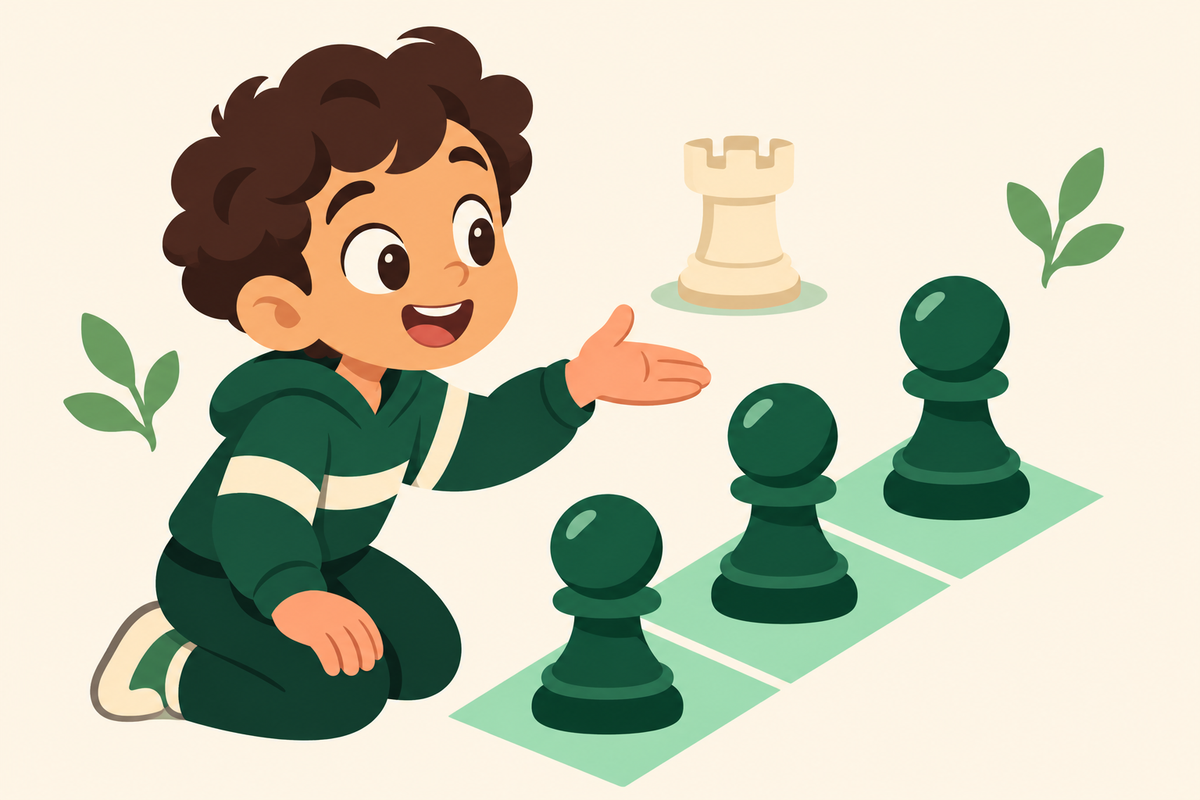
Pawn chains are connected lines of same-colour pawns on neighbouring diagonal squares. The pawn behind supports the one diagonally in front of it. To understand a chain, follow that support from the rear pawn toward the front, then ask what protects the rear pawn itself.
Do this before deciding whether the shape is strong or weak. Recognising a chain tells you something about the position, but it does not choose the next move for you.
Follow the direction of support
A pawn captures diagonally forward, not backwards. That means two pawns next to each other diagonally do not automatically protect each other in both directions. Start by identifying which way that colour’s pawns move, especially when viewing a board from Black’s side.
The pawn movement guide explains movement and captures. Ask your child to point to the squares each pawn attacks, rather than saying that the pawns are safe because they look close together.
Find the base of pawn chains
The base is the rearmost pawn in the chain. It is not supported by another pawn in that chain. It may still have protection from a king or piece, so “base” does not mean “free pawn.” The pawn-chain overview introduces this useful distinction and explains why opponents often examine the base as a target.
During a lesson, try three separate questions: Which pawn is the base? What protects it? What would change if it were exchanged? Let the child answer each one before moving on. Naming the structure and judging a capture are different jobs.
Pause before pushing a supporting pawn
Advancing a pawn changes the squares it attacks. Before a push, identify what that pawn currently supports; afterwards, check the support again. A move can gain something useful and give something up at the same time.
Use two short notes in your own study: “Before the move, this pawn supported…” and “After the move, it supports…” Then add any immediate threat you notice. The comparison is more informative than calling every pawn push good or bad.
The same habit helps when considering a capture. Our guide to exchanges encourages looking at what remains after the reply. Do not stop analysing at the moment a pawn takes something.
Try a chain-finding exercise in a finished game
Open a completed game and look for a diagonal line of friendly pawns.
Trace the support with your finger, starting at the back.
Name the base and check its defenders.
Find a later pawn move or capture that changes that line.
Compare the two positions and explain one difference in your own words.
If the game contains no clear chain, choose a different finished game or ask the coach for an example. You do not need to force every new term onto the first board you see. Keep this activity separate from a live competitive game, where the child should play independently.
A structure is a question, not an instruction
“Attack the base” can start an investigation. It is not permission to ignore a check, leave a piece undefended or make an unsound sacrifice. Compare the opponent’s reply before committing to a plan.
Likewise, a pawn that is not part of a chain is not automatically bad. Our guides to isolated pawns and doubled pawns help distinguish the shapes. Start with accurate observation; evaluation comes next.
If your child knows the moves but finds planning difficult, a free Project64 online demo is a chance to discuss their level. Bring an example of a position they found confusing and ask what skill would be useful to work on next.