What Is an Isolated Pawn in Chess? Look at the Neighbouring Files
An isolated pawn has no friendly pawn on either neighbouring file. It can still be defended by pieces, and its value depends on what is happening around it.
An isolated pawn is a pawn with no other pawn of the same colour on either neighbouring file. Look along the whole adjacent columns, not just at the squares immediately beside it. The pawn may still be protected by a king or another piece; “isolated” and “undefended” do not mean the same thing.
Start with the pawns of the same colour
For a white pawn on the d-file, inspect the c-file and e-file for white pawns. If neither contains one, the d-pawn is isolated. Black pawns on those columns do not provide friendly support. For an edge pawn on the a-file, there is only one neighbouring file to inspect: the b-file.
This isolated-pawn explanation describes the missing pawn support and why an isolated pawn is not automatically a bad pawn. The name identifies a feature of the position, not a verdict on who is winning.
Try a sorting exercise before studying a whole game
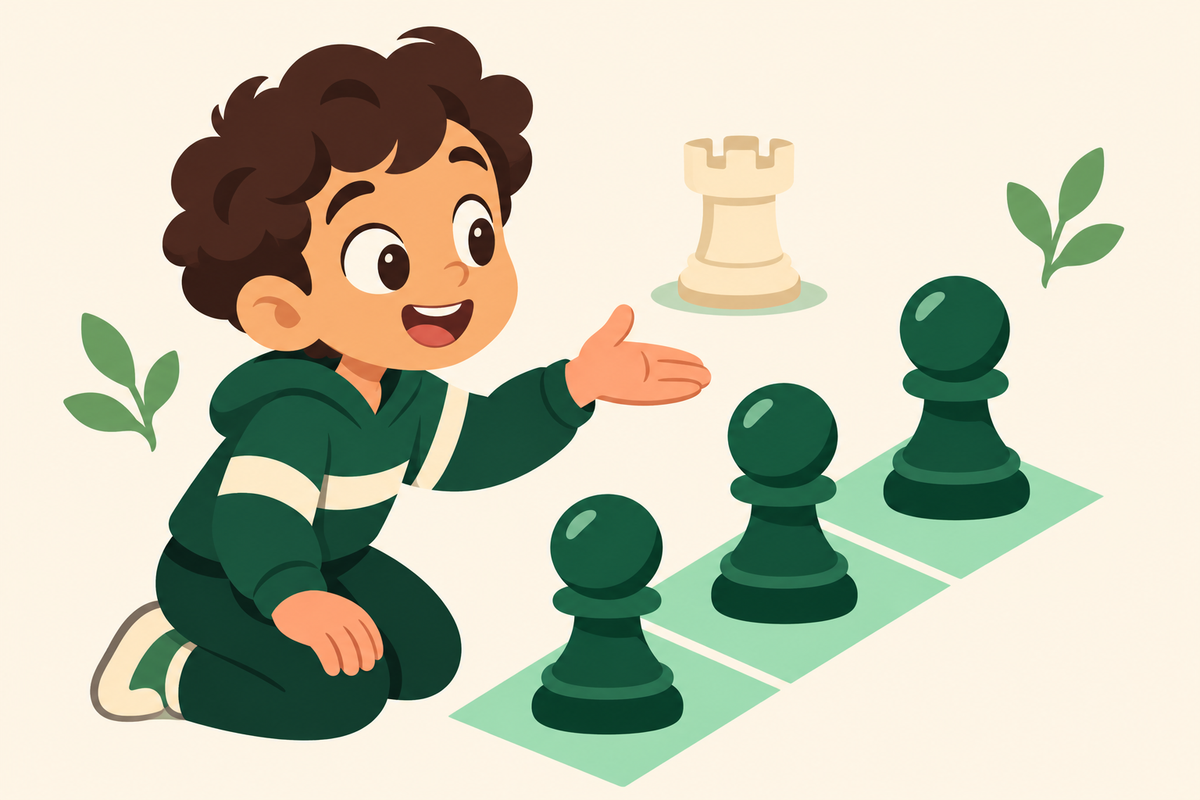
Use a board and just a few white pawns for this naming exercise. These arrangements are not complete chess positions and are not instructions for moves in a game.
Put white pawns on d4 and b2. The d4-pawn is isolated because there is no white pawn on the c-file or e-file.
Add a white pawn on c2. The d4-pawn is no longer isolated, even though the c2-pawn does not currently defend d4.
Remove the c2-pawn and put a white rook beside the board as a reminder to discuss piece support. A rook defending the d4-pawn in a real game would not change the pawn’s isolated status.
Ask the child to finish this sentence each time: “It is isolated because…” If the answer is merely “It is far away”, return to the neighbouring files. Distance across the board is not the test.
Check support separately
In a finished game, point to an isolated pawn and name its current defenders and attackers. Then ask what work those defenders are doing elsewhere. This creates a useful question for review: can a defender move away safely, or does the pawn depend on it?
Do not decide whether a capture works from the number of attackers alone. Follow the actual captures and replies, including checks. Our guide to trades offers a way to count what each side gives up.
Look for useful squares as well as weaknesses
An isolated pawn can influence important squares and help its pieces find activity. It can also become a target. In her explanation of isolated-pawn positions, Natalia Pogonina discusses both central-square influence and the opponent’s opportunity to blockade the pawn.
For a beginner, make that discussion concrete. Ask, “Which squares does this pawn attack?” and “What is on the square in front of it?” Then look at the pieces. A label alone cannot tell you whether pushing the pawn, defending it or using an active piece is best.
Can a passed pawn also be isolated?
Yes. “Isolated” describes the absence of friendly pawns on neighbouring files; “passed” describes the absence of enemy pawns ahead on its own or neighbouring files. One pawn can have both features. Our passed-pawn guide explains the second check.
When reviewing a game, write one question rather than a rule such as “Never allow an isolated pawn.” For example: “After this trade, what protected my d-pawn?” Bring the position to a coach and compare possible plans.
A free Project64 online demo can be a starting point for practising these observations. Share a game your child has played and let them explain what they noticed before asking for the answer.