How to Get Out of Check in Chess: Three Ways to Look
The king does not always have to move. Learn to consider a safe king move, a capture and a block, then compare three replies in one small practice position.
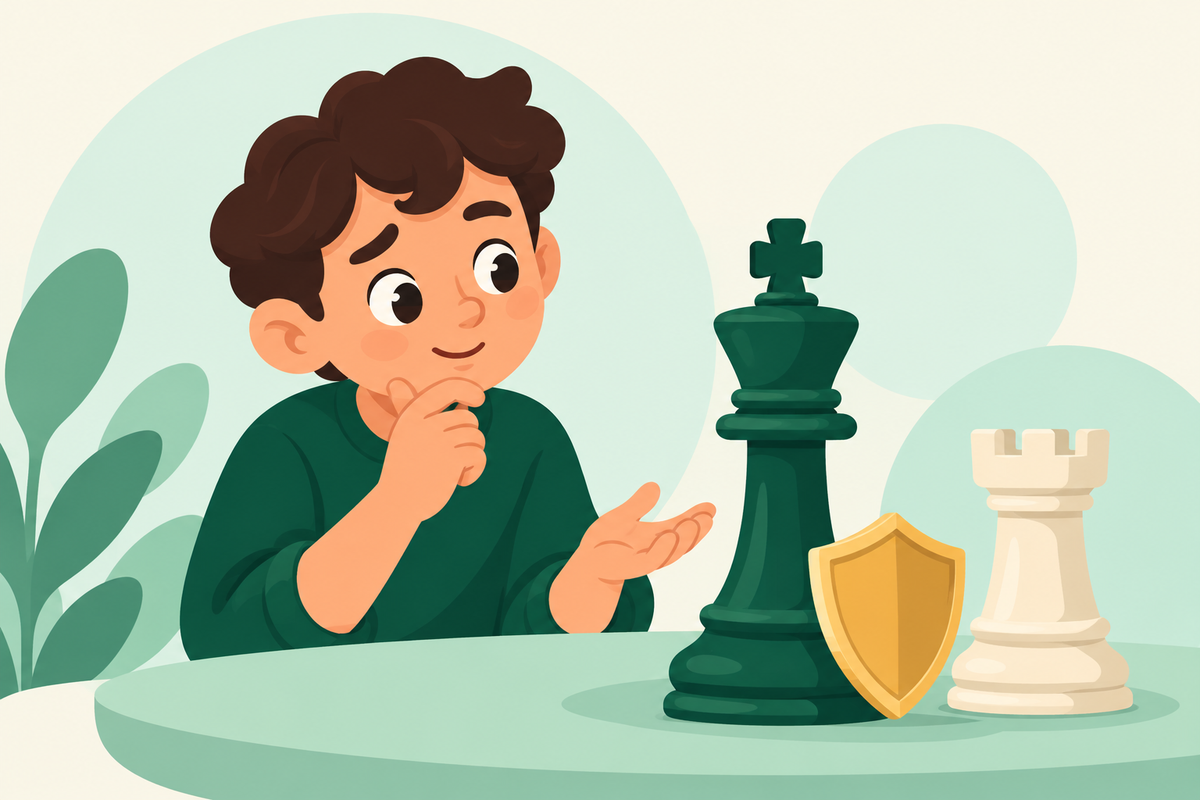
To get out of check, your move must leave your king safe. Sometimes you can move the king; sometimes another piece can capture the attacker or block its line. Do not assume that touching the king is the only answer. First identify the piece giving check, then look for legal replies.
What does check mean?
Check means that a king is attacked. It needs an immediate answer. The beginner explanation of check describes three types of response: moving the king to safety, capturing the checking piece, or putting a piece between the attacker and king. A position may offer several options, only one, or none.
Every candidate must pass the same final test: after the move, is your king still attacked? Under FIDE’s Laws of Chess, Article 3.9.2, leaving your king in check is illegal. Attacking the opponent’s queen does not excuse ignoring your own king.
One position, three different answers
Set up White’s king on e1, bishop on b5 and rook on h2. Black has a king on a8 and rook on e8. All other squares are empty, and White is to move. This is an original practice exercise, not a tournament game.
The black rook attacks down the e-file towards White’s king. Trace the empty squares between e8 and e1. Before trying the replays below, ask your child to find one way to stop that attack.
Move the king: Kf1. White’s king steps from e1 to f1. The rook on e8 does not attack f1, and the distant black king does not attack it either.
Block the line: Re2. White’s rook travels from h2 to e2, putting a piece between the attacking rook and the king. The white king remains on e1.
Capture the attacker: Bxe8. White’s bishop travels along b5–c6–d7–e8 and captures the black rook. The piece giving check is removed.
These are separate alternatives from the same starting position, not three moves to play in sequence. The exercise first asks whether each reply is legal. Then compare what White gains or gives up: capturing the rook removes material as well as the attack. Do not conclude that all legal replies are equally useful.
When a tempting answer does not work
You can block a line attack only when there is a square between the attacker and king. A knight’s check cannot be blocked, nor can a pawn’s check. Moving another piece somewhere else on the board does not help.
A king cannot capture an attacker if doing so lands it on an attacked square. Look beyond the piece you are taking. Another enemy piece may protect that square. Castling is also unavailable while the king is in check, as Article 3.8.2.2 makes clear; see the castling guide for the other conditions.
Try explaining the change
Use each practice replay below. Return to its starting position, play the reply, then ask: “What changed about the attack on e1?” Look for an explanation about the king’s square, the blocked line or the captured rook, rather than simply “the website allowed it.”
If the king is attacked and no legal reply exists, it is checkmate. Our checkmate and stalemate guide explains why a king with no moves is not automatically checkmated. Book a free Project64 online demo to practise these decisions with a coach at your child’s level.
White vs Black · *
White vs Black · *
White vs Black · *