En Passant in Chess: The Pawn Capture Explained
A pawn can sometimes capture a pawn beside it by moving diagonally to an empty square. Learn when en passant is legal and replay a simple example.
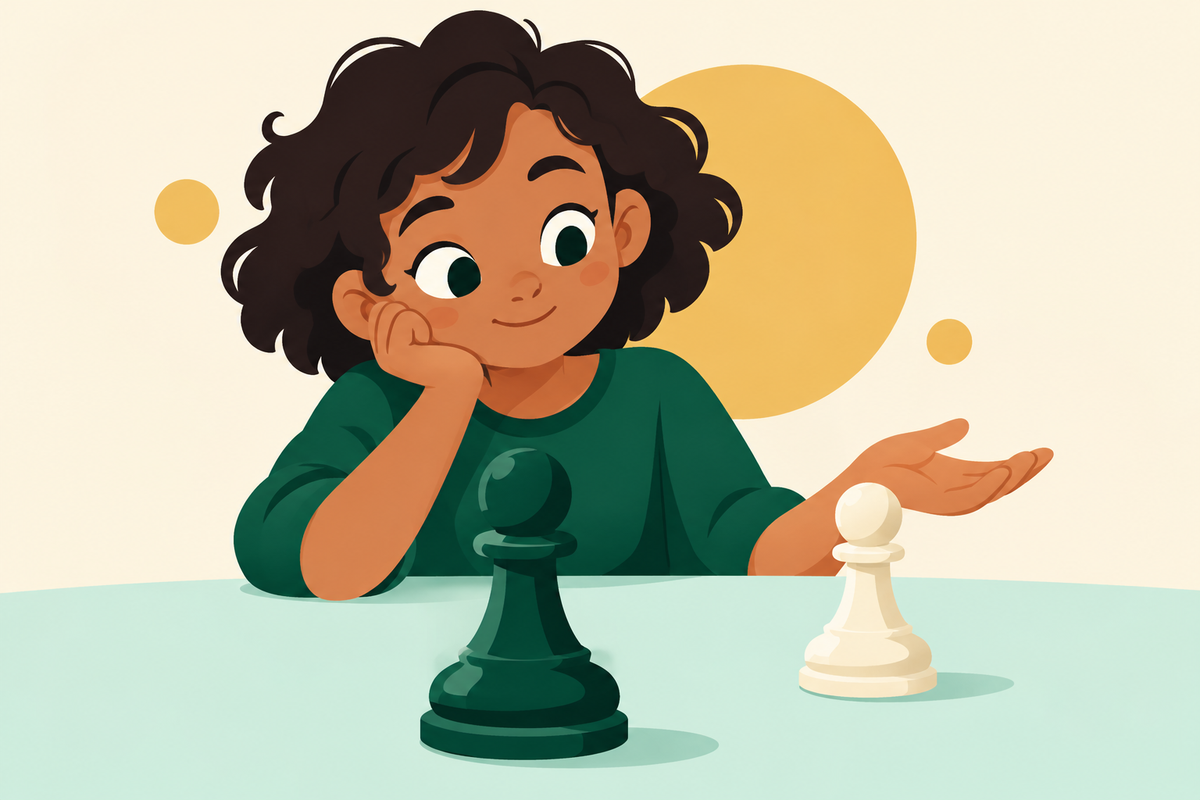
En passant is a special capture between pawns. If an opponent’s pawn advances two squares from its starting square and lands immediately beside your pawn, your pawn may be able to capture it as though it had moved only one square. You must make that capture on your very next move, and your king must remain safe.
The three squares to watch
In an ordinary capture, your piece lands on the occupied square. With en passant, keep track of three places: where your pawn starts, the empty square it moves to diagonally, and the neighbouring square from which the opponent’s pawn is removed.
For White, the capturing pawn starts on the fifth rank and lands on the sixth. For Black, it starts on the fourth rank and lands on the third. The move still goes diagonally forward. It is not a sideways pawn move.
Replay a four-piece example
Set up White’s king on e1 and pawn on e5, with Black’s king on e8 and pawn on d7. Leave the other squares empty. It is Black to move. This is a practice position, not a game played by an academy student.
Black plays d7–d5, moving two squares and arriving beside the white pawn.
White immediately plays e5xd6: move the white pawn diagonally from e5 to d6.
Remove the black pawn from d5. White’s pawn stays on d6.
The short notation is exd6. The “e” tells you the pawn’s starting file, “x” means a capture and “d6” is its landing square. Our beginner notation guide explains how to read other moves.
Check all the conditions
The FIDE Laws of Chess, Articles 3.7.3.1–2, define this capture and its timing. Before moving, check that:
The opponent’s last move was a pawn advancing two squares from its original square.
That pawn is now on the same rank and an adjacent file to your pawn.
You are taking the opportunity immediately, before making another move.
The resulting position does not leave your own king in check.
That last condition matters. Removing two pawns from their previous squares can uncover a rook, bishop or queen’s attack. A capture that exposes your own king is illegal, even if the other conditions look right.
Common questions
Can I wait until later? No. If you play a different move, this particular opportunity expires. A later two-square pawn advance could create a new opportunity elsewhere.
What if the pawn moved just one square? That does not create an en passant capture. Two separate one-square advances do not count as one two-square move.
Can a knight do it? No. This special capture is made by a pawn against a pawn. The illustrated en passant guide shows the difference from a normal capture.
Must I take it? There is no special rule requiring en passant. You may choose another legal move if one is available, as the official help explanation illustrates. Whether capturing is a good decision depends on the position.
Try the move, then explain it
In the board below, use the starting-position button, then step through d5 and exd6. Ask your child to name the pawn that disappeared and the square where White landed. If they can move the pieces but cannot explain why it was allowed, revisit the conditions together.
For another special pawn rule, read about pawn promotion. Book a free Project64 online demo if your child would benefit from practising the rules with a coach.
White vs Black · *