Checkmate vs Stalemate: A Simple Guide for Beginners
A trapped king does not always mean a win. Use two questions and two small board examples to tell checkmate from stalemate.
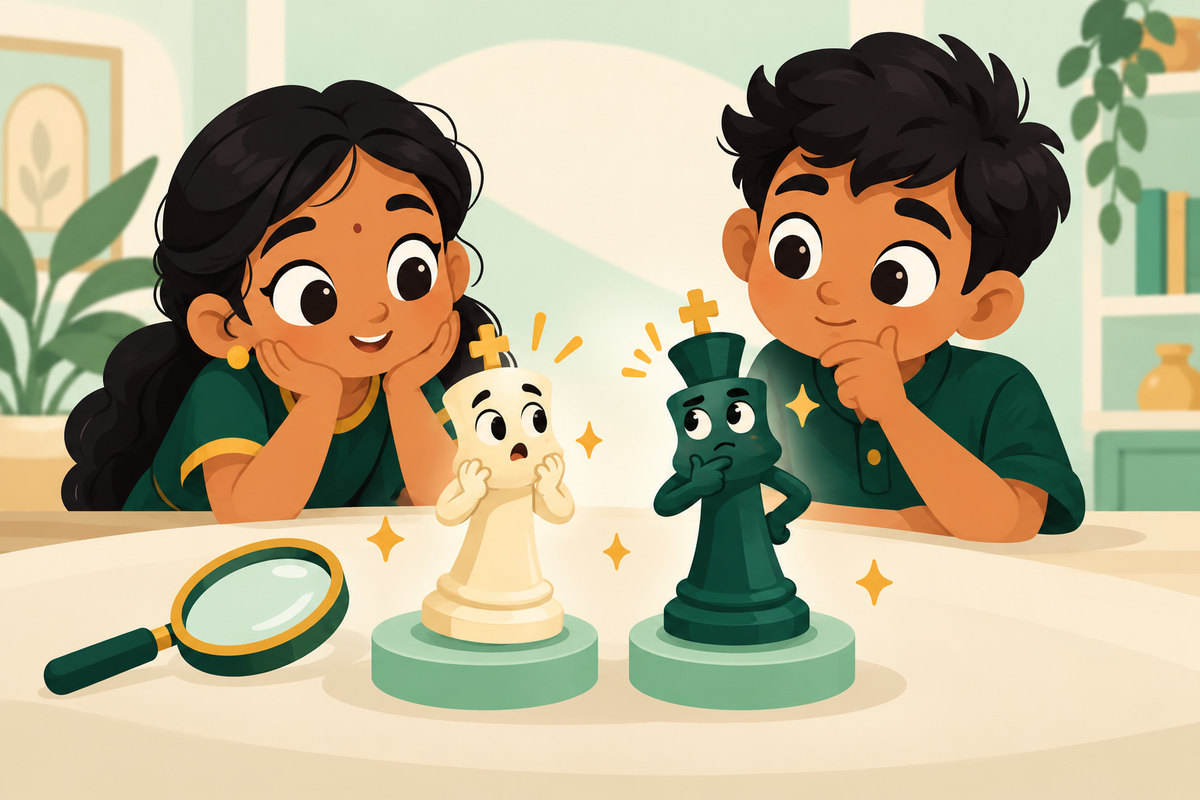
The difference between checkmate and stalemate is whether the king is in check. In checkmate, the king is attacked and there is no legal way to escape the check; the attacker wins. In stalemate, the player whose turn it is has no legal move, but their king is not attacked; the game is drawn.
For a beginner comparing checkmate vs stalemate, “the king cannot move” is not enough information. Start by asking whose turn it is, then examine the whole position.
Two questions to ask before announcing the result
Is the king in check? Identify the piece attacking it.
Does the player have any legal move? Consider every piece, not only the king.
When the king is in check, a legal reply must remove that check. Depending on the position, the reply might move the king, capture the attacker or block a line of attack. If no such reply exists, it is checkmate. These definitions follow FIDE’s Laws of Chess, Articles 3.9 and 5.
Example one: a queen gives checkmate
Use only three pieces. Put the white king on g6, the white queen on f7 and the black king on h8. It is White’s turn. Move the queen to g7. Now it is Black’s turn.
The queen on g7 attacks the black king on h8 diagonally. The square g8 is covered by the queen, and h7 is covered too. Black cannot capture the queen on g7 because the white king protects it. With no other black pieces to help, Black has no legal reply. This is checkmate.
The boards below open at their final positions. In the first example, use Starting position and then Next move to replay the queen move. The notation Qg7# means the queen moves to g7 and gives checkmate.
Example two: a queen causes stalemate
Reset the board for a separate example. Put the white king on g6, the white queen on e7 and the black king on h8. It is White’s turn. Move the queen to f7. Now it is Black’s turn.
This time the queen does not attack h8. However, g8 is covered by the queen’s diagonal, while g7 and h7 are covered by the white king. Black has no other pieces and no legal move. The position is stalemate: a draw, even though White has a queen.
Replay the second example in the same way to compare the endings. These are two separate teaching setups, not consecutive positions in one game.
Try both positions
Start by examining the displayed final positions. Before looking at the explanation again, point to every square the black king might try. Name the white piece that prevents each escape, then use the replay controls to see how the queen arrived there.
White vs Black · 1-0
White vs Black · 1/2-1/2
Common mistakes to watch for
Checking only the king: a player may have a legal pawn or piece move even when their king cannot move.
Counting an unsafe square as an escape: moving the king onto an attacked square is not legal.
Assuming an extra queen guarantees a win: in the second example, White’s extra material does not change the drawn result.
Calling every draw stalemate: stalemate is one particular kind of drawn position.
Practise checkmate vs stalemate together
Rebuild either final position on a physical board. Let your child be the detective: first name whose turn it is, then say whether the king is attacked, then inspect the possible moves. Ask for the reason before asking for the label.
If the coordinates are unfamiliar, find the letters along the board’s edge and the numbers along its side together. There is no need to add a timer. Once these examples feel clear, try the beginner activities on Lichess Learn or another position suggested by your child’s teacher.
Our home-practice guide has more small activities. If your child would benefit from someone explaining the positions with them, book a free Project64 online chess demo and mention the rule they are working on.