How to Read Chess Tournament Pairings and Find Your Board
Find the right section and round, then check the opponent, colour and board. Practise the routine at home so a pairing sheet feels familiar on tournament day.
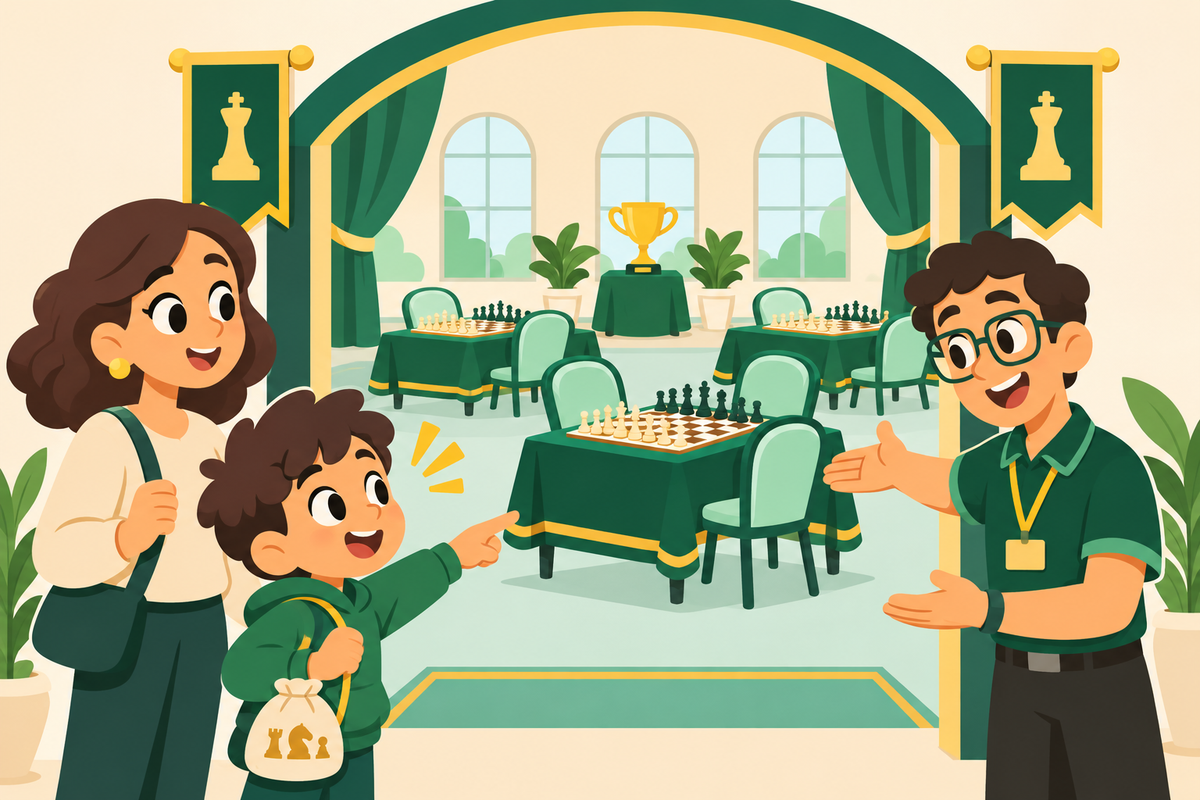
To read chess tournament pairings, first confirm the section and round, then find your child’s entry and note the opponent, assigned colour and board number. Read the column headings rather than guessing from the layout. A pairing list tells you where and against whom to play; it is not the same as the standings.
Start with the correct list
An event can have several age or playing-strength sections, each with its own pairings. Check the section name on your entry confirmation, the round number and whether the organiser has issued an updated list. A screenshot from the previous round can look perfectly convincing while sending you to the wrong place.
The South Carolina Chess Association’s first-tournament guide explains the basic relationship between a pairing entry, the opponent and the numbered board in the playing area. Its example uses White and Black columns. Other events may use a different layout, so the headings on your event’s list are the ones to follow.
Read one imaginary pairing
Here is a practice example created for this guide. The labels are placeholders, not real children or a real tournament result:
Section: Beginner practice event
Round: 2
Board: 12
White: Learner A
Black: Learner B
If your child were Learner B, they would go to board 12 and play the black pieces against Learner A. They would not go to board 2: that number identifies the round. Ask the child to explain the entry back to you before adding any extra columns.
Now imagine that the next round lists Learner B at board 7 with White. The child should follow the new assignment. Keeping the same seat or assuming the colour will alternate is not a safe substitute for reading each round’s list.
Separate board numbers from other numbers
A list may also show a player’s starting number, rating or current tournament points. Each describes something different:
Board: where this game is assigned.
Starting number or player number: an identifier within the event.
Rating: a playing-strength estimate under the named rating system.
Points: the player’s tournament score so far.
Read the label before copying a number. If two entries have similar names, use the event’s player details or ask staff to confirm the correct one. For the broader pairing process, see our guide to Swiss tournaments.
What if a name, opponent or board is missing?
Go to the organiser or arbiter before the round begins. Give the child’s name, section and round, and describe exactly what you cannot find. Do not choose a spare board, change opponents or assume that a missing opponent means the child can leave.
A bye or other special entry needs the event’s explanation. Our guide to tournament byes explains why an unplayed round can have different meanings. If your child needs to leave, tell the organiser and ask what to do about any remaining rounds.
Practise the handover, not just finding a seat
Before tournament day, write a few invented pairing entries on paper and ask your child to pick out the three useful details: board, colour and opponent. Then rehearse asking a helper, “Please can you help me find my board?” This is a practical routine, not a test of memory.
At the venue, check where parents are allowed and agree on a meeting place after the game. If adults must stay outside the playing area, ask how a helper will guide younger children. Check the next-round time separately; the board assignment alone does not tell you when play starts.
For a child getting ready for their first event, a free Project64 online demo can help identify useful skills to practise. Bring the event information and one or two questions, alongside any chess positions your child wants help understanding.