How to Solve Chess Puzzles Without Guessing
A correct click is only the start. Use a simple routine to read the position, consider a reply and explain the solution before moving to the next puzzle.
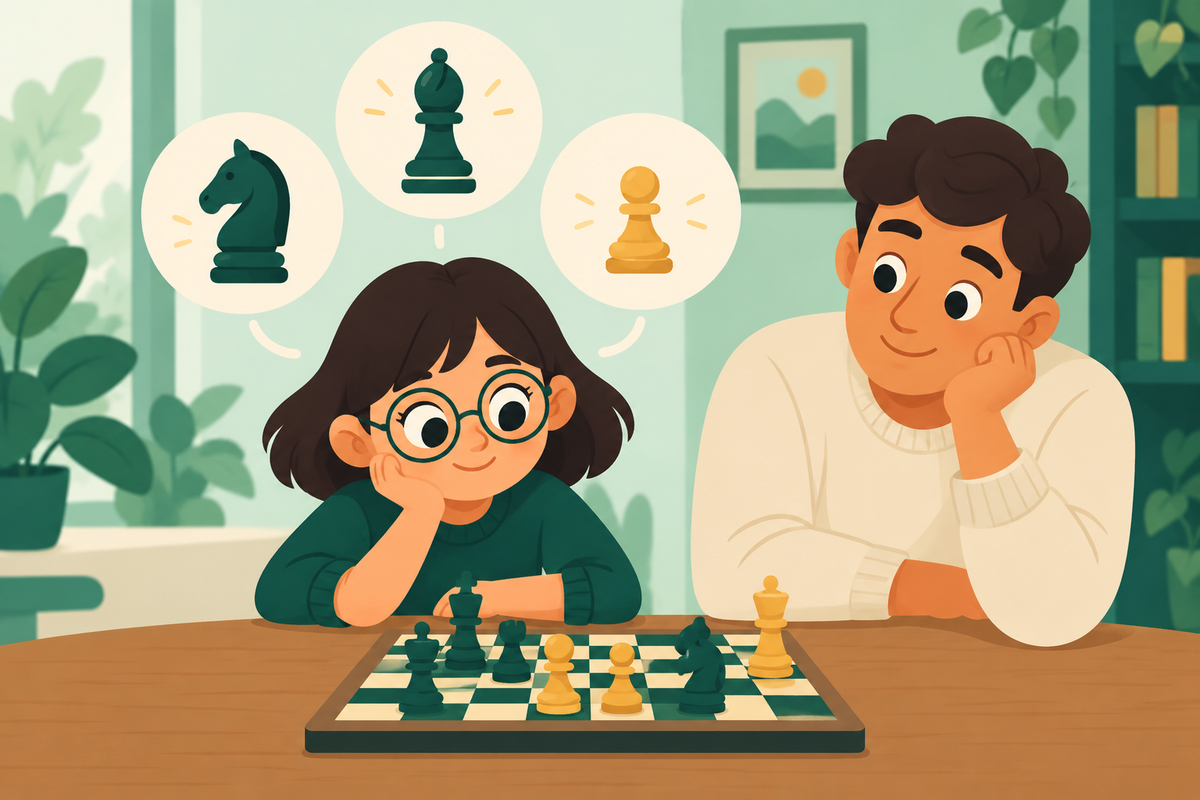
To solve chess puzzles, first identify whose turn it is and what the position asks you to achieve. Choose a possible move, check the opponent’s strongest reply and explain why your idea works before playing it. The aim is to understand a decision, not to keep clicking until the screen accepts an answer.
For a beginner, start with a task connected to a recent lesson. A puzzle that depends on an unfamiliar rule can feel like a guessing game even when the child is trying carefully.
Choose a puzzle with a clear learning purpose
Ask the coach for an appropriate theme, such as finding an unprotected piece or checkmate in one. Lichess groups puzzles by themes, including forks, hanging pieces and different kinds of endings. A theme helps you choose a task; it is not evidence that every position in that category will suit your child.
If piece movement itself is still uncertain, begin with basic movement exercises instead. The Lichess learning area is one place to explore chess basics with a parent. Follow your coach’s guidance when choosing what to try next.
A five-step puzzle routine
Read the board. Find both kings, confirm the side to move and check whether that king is already under attack.
Read the task. Is the goal checkmate in one, winning material or finding a useful continuation? Do not assume every puzzle ends in mate.
Choose a candidate. Look for relevant checks, captures and threats. A move being a check does not automatically make it the answer.
Give the opponent a turn. Ask what they could capture, block or move away. Try to find the reply that causes your idea the most trouble.
Explain and then move. Describe the expected continuation. After seeing the solution, check what you understood and what you missed.
Use this as a learning routine, not a script to recite perfectly. At first, a child may only manage one question at a time.
Make “checkmate in one” a real question
When a puzzle asks for mate in one, saying “my queen gives check” is incomplete. Ask whether the defending king can escape, whether the checking piece can be captured and whether the attack can be blocked. The move must leave no legal way out of check.
Let your child demonstrate a possible defence on a practice board after they have thought about it. If the distinction is unclear, revisit our checkmate and stalemate guide before adding harder puzzles.
What to do after a wrong answer
Return to the position before the mistake. Ask, “Which reply did we miss?” rather than immediately revealing the next move. A small hint might be to look at the opponent’s rook, or to check whether a square is protected.
If you do not know why the solution works, save the puzzle link and your child’s question for the coach. There is no need to invent an explanation. Once the idea is clear, replay it and let the child explain the important reply in their own words.
Connect puzzles to actual games
A chess puzzle provides a signal that there is something to find. A game does not announce when a useful opportunity has appeared. After practice, look at one completed game together and ask whether a similar idea occurred. Avoid interrupting a live competitive game with hints.
For an easy starting connection, practise noticing loose pieces using our beginner safety checklist. Judge the session by what your child can explain, rather than how many puzzles they completed.
Project64’s live online classes include coach-assigned practice connected to lessons. Book a free demo to discuss your child’s current level and the kinds of puzzles that would make a useful next step.