Threefold Repetition in Chess: Count Positions, Not Moves
Moving a piece back and forth is not the whole rule. Replay a short knight exercise and count the same position from its first appearance.
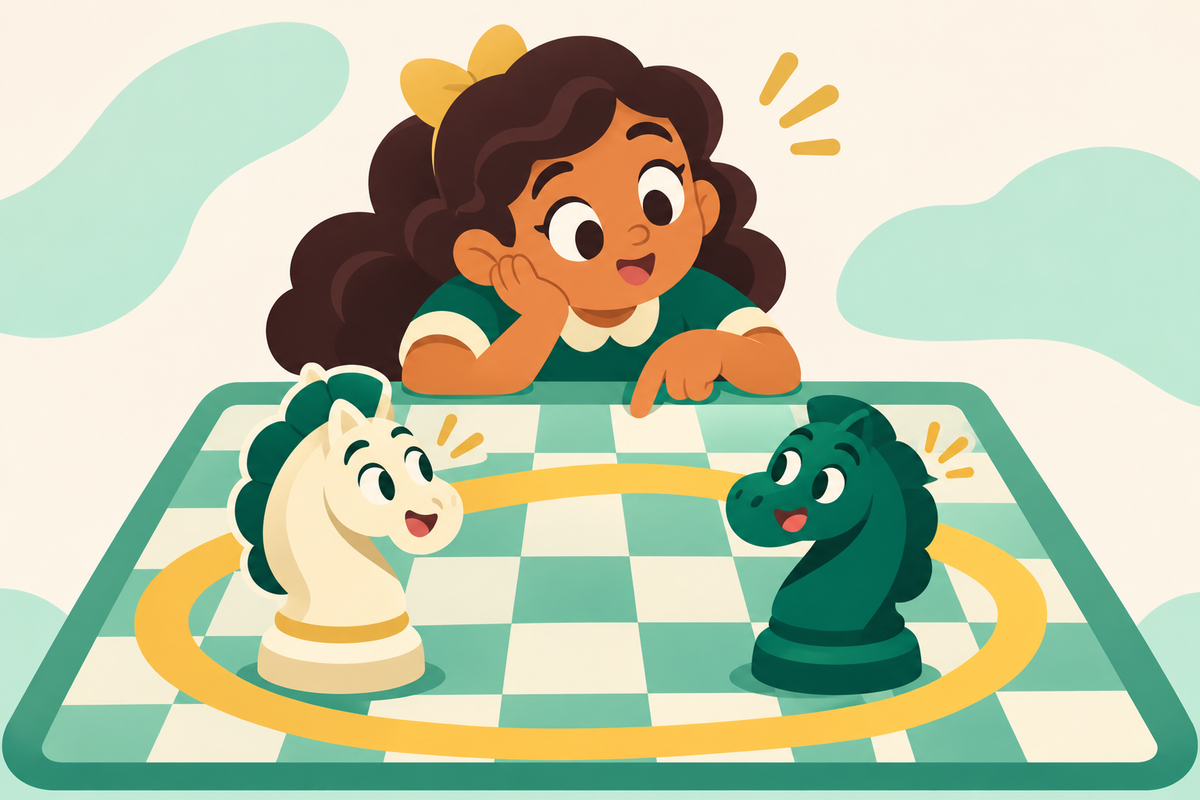
Threefold repetition concerns the same chess position appearing three times, not simply a piece making the same move three times. Under FIDE’s over-the-board rules, a correct claim by the player whose turn it is makes the game a draw. The occurrences need not be consecutive.
What has to match?
The player to move, the kinds and colours of pieces on each square, and the available moves must match. Castling rights and an available en passant capture matter. A familiar-looking board alone is not enough. These conditions are set out in FIDE’s Laws of Chess, Article 9.2.
Try a knight round trip
The interactive board below starts from the normal initial position. Select Starting position. Before making any move, count this as the first appearance: all the pieces are at home and it is White’s turn.
Use Next move to follow this practice sequence:
1. Nf3 Nf6 2. Ng1 Ng8
White’s knight travels from g1 to f3 and back. Black’s knight travels from g8 to f6 and back. After Black returns to g8, compare the whole board with the start. No pawn has moved, neither king nor rook has moved, and White is again to play. This is the second appearance of the initial position.
Now continue:
3. Nf3 Nf6 4. Ng1 Ng8
At the end, the same starting position appears for the third time. White is again to move. We needed two complete round trips after the first appearance, not three. Reset the board and count the matching moments at the start, after move two for Black, and after move four for Black.
This is a deliberately simple teaching exercise, not an opening recommendation or a game played by named competitors. The players could choose different moves; nothing in the example forces them to repeat.
Use a comparison checklist
During practice, pause at each return and ask your child to point out the evidence rather than saying only, “It looks the same.” Try these prompts:
Where are the two knights now?
Did any other piece move during the exercise?
Whose turn follows Black’s return?
How many matching moments have we counted, including the start?
Then ask a prediction question: if White played a pawn move instead of the next knight move, would this round trip still return every piece to its starting square? Let the child explain using the board. The aim is careful comparison, not memorising eight clicks.
How a tournament claim differs from the exercise
Claim before touching a piece: if the third occurrence has just arrived, the player to move can claim. If an intended move will produce it, record that move first and tell the arbiter before playing it. Pause the clock for the claim; the arbiter checks it. An incorrect claim can be penalised. Five occurrences produce an automatic draw under Article 9.6.1.
Practise the procedure with the coach before tournament day. Ask the organiser how children should summon the arbiter and clarify the applicable time-control rules. Do not substitute a website’s automatic ending for learning the over-the-board procedure.
Make the next lesson about one clear question
If the move letters are unfamiliar, begin with our chess notation guide. For a different drawn ending, compare checkmate and stalemate. Keep each idea separate while your child is learning the rules.
Want help moving from piece movement to complete games? Book a free Project64 online demo and tell the coach which rules your child finds confusing.
White vs Black · *