Can My Child Learn Chess If I Don’t Know How to Play?
You do not need to become the family chess expert. Use the first lesson to check how the coach explains, how your child responds and what support is expected at home.
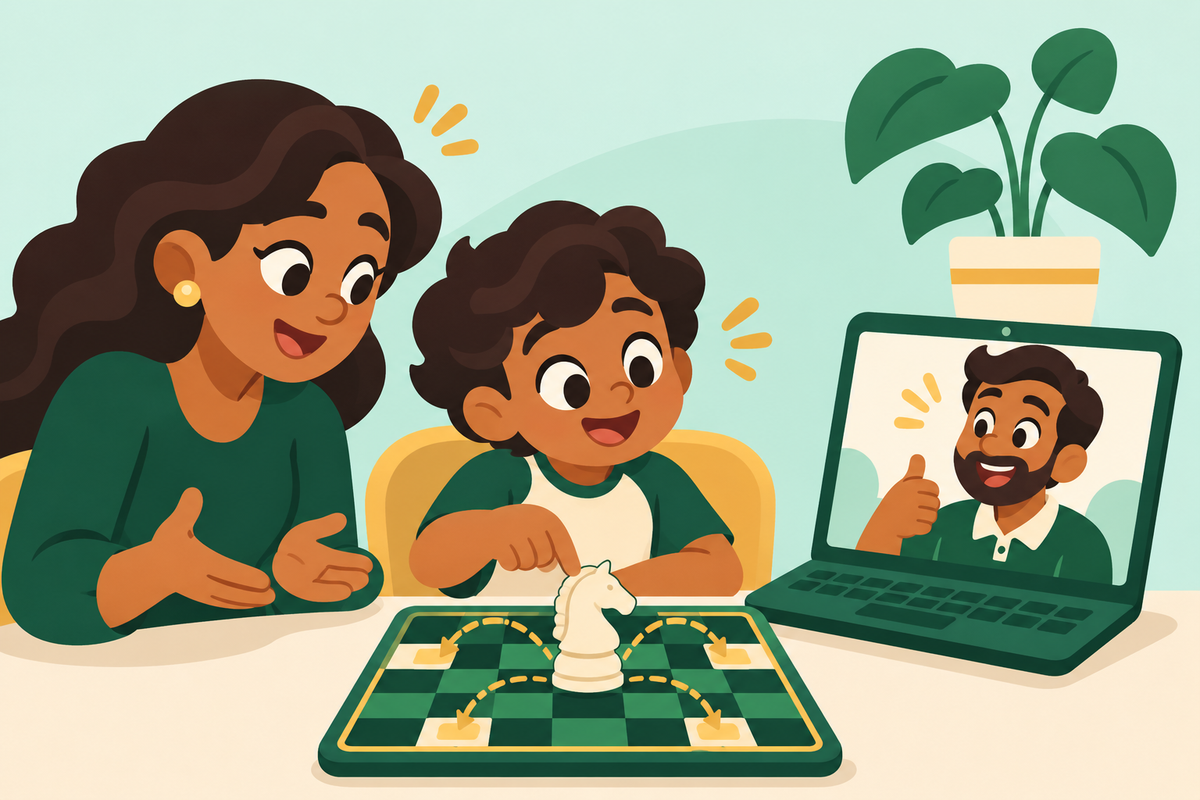
Yes. Your child can learn chess with a teacher even if you do not know the moves. Your role can be arranging a workable routine, helping with the lesson setup and keeping communication open. Before enrolling, ask the academy how it supports children whose parents cannot explain a chess exercise at home.
You do not have to assess a complicated position to notice whether a lesson is understandable. Watch how the coach responds to a question, whether your child gets a turn to try an idea and whether the next task is clear. Those observations make a useful starting point for choosing a class.
Say that you are new to chess at the first conversation
A simple introduction helps: “My child wants to learn chess, but I do not play. Please explain what they will need to do independently and what you will need from me.” There is no need to hide your lack of experience or learn opening names before speaking to a coach.
Ask for an example of a normal week. Who assigns practice? How does the child find it? What happens when they cannot solve it? Is an adult expected to check the answers, or only help the child access the activity? The answers reveal whether the arrangement fits your household.
What a non-playing parent can observe in a demo
A clear task: can your child explain what they have been asked to try, even if they cannot yet solve it?
Room to respond: does the coach wait for the child to think and attempt a move?
A useful response to mistakes: does the explanation help the child see what to check next?
A suitable starting point: does the coach find out what the child already knows instead of assuming prior lessons?
An understandable next step: can you describe what the child will work on after the session?
A child can be quiet or uncertain in a first meeting. Use the observations to ask questions, rather than treating one hesitant answer as a failed trial. Our first-demo preparation guide covers the practical setup.
Ask for feedback that does not require chess vocabulary
If a coach says, “We are working on undefended pieces,” ask for a small example and the next practice task. A useful explanation might be, “We are practising noticing which pieces the opponent could take.” You can understand the learning goal without checking every move yourself.
Keep three questions for a progress conversation: What can my child do independently now? What still needs a prompt? What should they try next? Ask to see an example from their own work. Wins and ratings can be discussed, but they do not replace an explanation of the skill being taught.
You can be interested without supplying the answer
After a lesson, invite your child to show you one idea if they feel like it. Let them move the pieces and explain. If neither of you knows whether an answer is right, save the position or question for the coach. You can say, “I don’t know yet; let’s ask,” without turning the evening into another lesson.
The Chess in Education coalition’s parent FAQ also addresses families who do not play, suggesting encouragement, simple activities and questions. Learning the basics yourself is an option, not a condition for arranging lessons.
For a specific homework difficulty, our guide to helping with chess homework explains how to support an attempt without completing it for the child. Keep discussion of competitive games for afterwards; the child should make their own decisions during play.
Discuss the support you actually need
Project64 offers live 1:1 and group classes, coach-assigned practice and parent updates about attendance, practice and developing skills. Book a free online demo and tell the team that you are new to chess. Use the conversation to agree on a manageable role for you and a clear starting point for your child.