Can the King Catch the Pawn? Learn the Rule of the Square
Put just three pieces on the board and change whose turn it is. One extra king move decides whether the pawn becomes a queen or disappears.
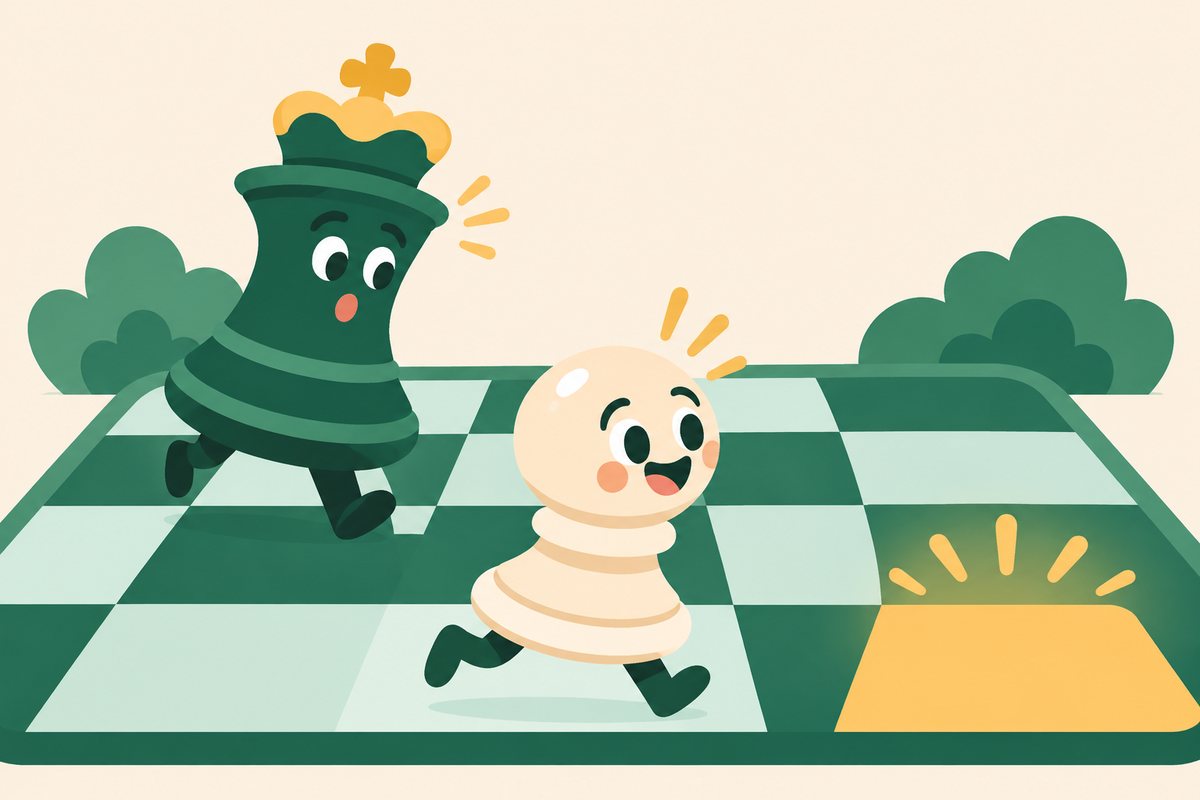
A king can move diagonally, so it can catch some pawns that look far away. The rule of the square is a way to see whether a lone king can catch an unassisted pawn running straight to promotion. Look at the pawn’s distance to the last rank, draw an imaginary square towards the king, and check whose turn it is.
Build the square from the pawn
Put a white pawn on c4, the white king on a1 and the black king on h8. White’s king will stay out of this exercise. The pawn needs four moves to reach c8. Trace those four steps up the c-file, then trace four steps sideways from c4 towards Black’s king. You land on g4. The corners of the square are c4, c8, g8 and g4.
Black’s king on h8 stands just outside. The edge counts as part of the square. If it is the defender’s turn and the king can enter that square now, it can catch an unsupported pawn on a clear board. If the pawn moves first, draw the smaller square from its new home before you judge the king’s chances.
What happens when White moves first?
Play c5. Now the right edge of the square runs along the f-file. Black can reach g7 in one move, but still sits outside. Continue with c6 and ...Kf7, then c7 and ...Ke7. On the next move White promotes on c8. Black’s king on e7 is too far away to capture the queen.
Notice what the king did well. It walked towards the pawn with every move. White’s head start was enough to make that chase fail.
What happens when Black moves first?
Reset the same three pieces. This time Black plays ...Kg7 before the pawn moves. The king has stepped onto the edge of the original square. After c5 it goes to f7, after c6 it goes to e7, and after c7 it goes to d7.
White can still play c8=Q+, promoting with check. But now the king is one step from c8, and the queen on that square has no defender. Black captures it. Only the two kings remain, so the game is drawn. Counting only as far as the promotion move would miss the point of the exercise.
Try both races with your child
The two boards below have identical pieces and different starting turns. Select Starting position on each board. Before revealing a move, ask your child to point to the far edge of the square. Step through both lines and pause just before promotion. Can the black king capture on c8 on its next turn?
If your child wants to try it on a physical board, change just one thing at a time. Keep White to move and slide the black king from h8 to g8. Ask for a prediction, then let the child play the defender. Each time the pawn advances, they can trace the new square with a finger.
When should we count the actual moves?
The shortcut assumes a clear route. A friendly king protecting the pawn, an occupied square or a square under attack can change the result. A pawn on its starting rank may also have a legal two-square first move. Account for that head start before drawing the square. When in doubt, play out the legal moves through the defender’s reply to promotion.
For the promotion rule itself, see our beginner guide to pawn promotion. For further exercises, the opening lesson in Pawn Play in the Endgame also teaches the square.
At a free Project64 online demo, your child can try a position and explain their choice to a coach. For this one, a good question to bring is “What changes when Black gets the first move?”
White vs Black · *
White vs Black · *